Reproducing Polynomials with B-Splines

A B-Spline of order Fehler beim Parsen (MathML mit SVG- oder PNG-Rückgriff (empfohlen für moderne Browser und Barrierefreiheitswerkzeuge): Ungültige Antwort („Math extension cannot connect to Restbase.“) von Server „https://wikimedia.org/api/rest_v1/“:): {\displaystyle N} is known to be able to reproduce any polynomial up to order Fehler beim Parsen (MathML mit SVG- oder PNG-Rückgriff (empfohlen für moderne Browser und Barrierefreiheitswerkzeuge): Ungültige Antwort („Math extension cannot connect to Restbase.“) von Server „https://wikimedia.org/api/rest_v1/“:): {\displaystyle N} [1]:
Fehler beim Parsen (MathML mit SVG- oder PNG-Rückgriff (empfohlen für moderne Browser und Barrierefreiheitswerkzeuge): Ungültige Antwort („Math extension cannot connect to Restbase.“) von Server „https://wikimedia.org/api/rest_v1/“:): {\displaystyle \sum_{n \in \mathbb{Z}} c_{m,n} \beta_N (t - n) = t^m }
In words, a proper linear combination of shifted versions of a B-Spline can reproduce any polynomial up to order Fehler beim Parsen (MathML mit SVG- oder PNG-Rückgriff (empfohlen für moderne Browser und Barrierefreiheitswerkzeuge): Ungültige Antwort („Math extension cannot connect to Restbase.“) von Server „https://wikimedia.org/api/rest_v1/“:): {\displaystyle N} . This is needed for different applications, for example, for the Sampling at Finite Rate of Innovation (FRI) framework[2]. In this case any kernel Fehler beim Parsen (MathML mit SVG- oder PNG-Rückgriff (empfohlen für moderne Browser und Barrierefreiheitswerkzeuge): Ungültige Antwort („Math extension cannot connect to Restbase.“) von Server „https://wikimedia.org/api/rest_v1/“:): {\displaystyle \varphi} reproducing polynomials (that is, satisfying the Strang-Fix conditions) can be used. However, among all possible kernels, the B-Splines have the smallest possible support.
An important question is how to obtain the coefficients Fehler beim Parsen (MathML mit SVG- oder PNG-Rückgriff (empfohlen für moderne Browser und Barrierefreiheitswerkzeuge): Ungültige Antwort („Math extension cannot connect to Restbase.“) von Server „https://wikimedia.org/api/rest_v1/“:): {\displaystyle c_{m,n}} for the reproduction-formula. In this small article, I describe one way.
Starting from
Fehler beim Parsen (MathML mit SVG- oder PNG-Rückgriff (empfohlen für moderne Browser und Barrierefreiheitswerkzeuge): Ungültige Antwort („Math extension cannot connect to Restbase.“) von Server „https://wikimedia.org/api/rest_v1/“:): {\displaystyle \sum_{n \in \mathbb{Z}} c_{m,n} \varphi(t - n) = t^m }
the coefficients can be obtained using the dual of Fehler beim Parsen (MathML mit SVG- oder PNG-Rückgriff (empfohlen für moderne Browser und Barrierefreiheitswerkzeuge): Ungültige Antwort („Math extension cannot connect to Restbase.“) von Server „https://wikimedia.org/api/rest_v1/“:): {\displaystyle \varphi} , Fehler beim Parsen (MathML mit SVG- oder PNG-Rückgriff (empfohlen für moderne Browser und Barrierefreiheitswerkzeuge): Ungültige Antwort („Math extension cannot connect to Restbase.“) von Server „https://wikimedia.org/api/rest_v1/“:): {\displaystyle \tilde{\varphi}} (I set Fehler beim Parsen (MathML mit SVG- oder PNG-Rückgriff (empfohlen für moderne Browser und Barrierefreiheitswerkzeuge): Ungültige Antwort („Math extension cannot connect to Restbase.“) von Server „https://wikimedia.org/api/rest_v1/“:): {\displaystyle \beta_N = \varphi} for consistency with my notes):
Fehler beim Parsen (MathML mit SVG- oder PNG-Rückgriff (empfohlen für moderne Browser und Barrierefreiheitswerkzeuge): Ungültige Antwort („Math extension cannot connect to Restbase.“) von Server „https://wikimedia.org/api/rest_v1/“:): {\displaystyle c_{m,n} = \int_{-\infty}^{\infty} t^m \tilde{\varphi}(t - n)\,dt }
However, even if the dual would be known, solving the infinite integral is only feasible when the dual has finite support. This is the case with the B-Spline itself but not with its dual!
A closer look at the formula tells that this is nothing more than a convolution (under the assumption that Fehler beim Parsen (MathML mit SVG- oder PNG-Rückgriff (empfohlen für moderne Browser und Barrierefreiheitswerkzeuge): Ungültige Antwort („Math extension cannot connect to Restbase.“) von Server „https://wikimedia.org/api/rest_v1/“:): {\displaystyle \tilde{\varphi}} is symmetric which is the case):
Fehler beim Parsen (MathML mit SVG- oder PNG-Rückgriff (empfohlen für moderne Browser und Barrierefreiheitswerkzeuge): Ungültige Antwort („Math extension cannot connect to Restbase.“) von Server „https://wikimedia.org/api/rest_v1/“:): {\displaystyle c_{m,n} = \int t^m \tilde{\varphi}(-(n-t))\,dt = \int t^m \tilde{\varphi}(n-t)\,dt = (t^m * \tilde{\varphi})(n) }
Now, this can be transformed to fourier domain:
Fehler beim Parsen (MathML mit SVG- oder PNG-Rückgriff (empfohlen für moderne Browser und Barrierefreiheitswerkzeuge): Ungültige Antwort („Math extension cannot connect to Restbase.“) von Server „https://wikimedia.org/api/rest_v1/“:): {\displaystyle (t^m * \tilde{\varphi})(n) = \mathcal{F}^{-1}\left\{ \mathcal{F}\left\{t^m\right\} \tilde{\Phi}(\omega)\right\} = \mathcal{F}^{-1}\left\{ j^m \sqrt{2\pi} \delta^{(n)}(\omega) \tilde{\Phi}(\omega) \right\} = j^m \sqrt{2\pi} \mathcal{F}^{-1}\left\{\delta^{(n)}(\omega) \tilde{\Phi}(\omega) \right\} }
Writing the inverse of this expression yields:
Fehler beim Parsen (MathML mit SVG- oder PNG-Rückgriff (empfohlen für moderne Browser und Barrierefreiheitswerkzeuge): Ungültige Antwort („Math extension cannot connect to Restbase.“) von Server „https://wikimedia.org/api/rest_v1/“:): {\displaystyle j^m \sqrt{2\pi} \frac{1}{\sqrt{2\pi}} \int_{-\pi}^{\pi} \delta^{(n)}(\omega) \tilde{\Phi}(\omega) e^{j\omega n}\,d\omega = j^m \int_{-\infty}^{\infty} \delta^{(n)}(\omega) \underbrace{\tilde{\Phi}(\omega) e^{j\omega n}}_{f(\omega)}\,d\omega }
It is known that[3]:
Fehler beim Parsen (MathML mit SVG- oder PNG-Rückgriff (empfohlen für moderne Browser und Barrierefreiheitswerkzeuge): Ungültige Antwort („Math extension cannot connect to Restbase.“) von Server „https://wikimedia.org/api/rest_v1/“:): {\displaystyle \int \delta^{(n)}(x) f(x)\,dx = (-1)^n f^{(n)}(0) }
so that
Fehler beim Parsen (MathML mit SVG- oder PNG-Rückgriff (empfohlen für moderne Browser und Barrierefreiheitswerkzeuge): Ungültige Antwort („Math extension cannot connect to Restbase.“) von Server „https://wikimedia.org/api/rest_v1/“:): {\displaystyle j^m \int_{-\infty}^{\infty} \delta^{(n)}(\omega) f(\omega)\,d\omega = j^m (-1)^m \left. \frac{\partial^m}{\partial \omega^m} f(\omega) \right|_{\omega = 0} }
Now the whole procedure has been reduced to calculate the derivative of Fehler beim Parsen (MathML mit SVG- oder PNG-Rückgriff (empfohlen für moderne Browser und Barrierefreiheitswerkzeuge): Ungültige Antwort („Math extension cannot connect to Restbase.“) von Server „https://wikimedia.org/api/rest_v1/“:): {\displaystyle f(\omega)} and set the result to zero.
An open question is how to obtain the dual of Fehler beim Parsen (MathML mit SVG- oder PNG-Rückgriff (empfohlen für moderne Browser und Barrierefreiheitswerkzeuge): Ungültige Antwort („Math extension cannot connect to Restbase.“) von Server „https://wikimedia.org/api/rest_v1/“:): {\displaystyle \varphi} . As the reproduction formula spans a vector space, the must be at least bi-orthogonal to . This translates in fourier domain to[4]:


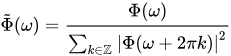
The fourier transform of a B-Spline of order is (e.g. [5]):

Fehler beim Parsen (MathML mit SVG- oder PNG-Rückgriff (empfohlen für moderne Browser und Barrierefreiheitswerkzeuge): Ungültige Antwort („Math extension cannot connect to Restbase.“) von Server „https://wikimedia.org/api/rest_v1/“:): {\displaystyle \Beta_N(\omega) = \Phi(\omega) = \left( \frac{\sin(\omega/2)}{\omega/2} \right)^{N+1} = \mathrm{sinc}^{N+1}(\omega/2) }
The following derivation of the sum is borrowed from [6]. For this derivation to work, I set Fehler beim Parsen (MathML mit SVG- oder PNG-Rückgriff (empfohlen für moderne Browser und Barrierefreiheitswerkzeuge): Ungültige Antwort („Math extension cannot connect to Restbase.“) von Server „https://wikimedia.org/api/rest_v1/“:): {\displaystyle L=N+1} temprarily:
Fehler beim Parsen (MathML mit SVG- oder PNG-Rückgriff (empfohlen für moderne Browser und Barrierefreiheitswerkzeuge): Ungültige Antwort („Math extension cannot connect to Restbase.“) von Server „https://wikimedia.org/api/rest_v1/“:): {\displaystyle \sum_{k \in \mathbb{Z}} |\Phi(\omega + 2\pi k)|^2 = \sum_{k \in \mathbb{Z}} \left|\mathrm{sinc}\left(\frac{1}{2}(\omega + 2\pi k)\right)^L \right|^2 = \sum_{k \in \mathbb{Z}} \left|\mathrm{sinc}\left(\frac{1}{2}(\omega + 2\pi k)\right) \right|^{2L} }
and because Fehler beim Parsen (MathML mit SVG- oder PNG-Rückgriff (empfohlen für moderne Browser und Barrierefreiheitswerkzeuge): Ungültige Antwort („Math extension cannot connect to Restbase.“) von Server „https://wikimedia.org/api/rest_v1/“:): {\displaystyle 2L} is always even:
Fehler beim Parsen (MathML mit SVG- oder PNG-Rückgriff (empfohlen für moderne Browser und Barrierefreiheitswerkzeuge): Ungültige Antwort („Math extension cannot connect to Restbase.“) von Server „https://wikimedia.org/api/rest_v1/“:): {\displaystyle = \sum_{k \in \mathbb{Z}}\frac{\sin^{2L}(\frac{1}{2}(\omega + 2\pi k))}{\left(\frac{1}{2}(\omega + 2\pi k)\right)^{2L}} = \sum_{k \in \mathbb{Z}}\frac{\sin^{2L}(\frac{\omega}{2} + \pi k))}{(\frac{\omega}{2} + \pi k)^{2L}} }
Because of the periodicity it is known that
Fehler beim Parsen (MathML mit SVG- oder PNG-Rückgriff (empfohlen für moderne Browser und Barrierefreiheitswerkzeuge): Ungültige Antwort („Math extension cannot connect to Restbase.“) von Server „https://wikimedia.org/api/rest_v1/“:): {\displaystyle \sin^{2L}(x + \pi k) = \sin^{2L}(x) }
such that
Fehler beim Parsen (MathML mit SVG- oder PNG-Rückgriff (empfohlen für moderne Browser und Barrierefreiheitswerkzeuge): Ungültige Antwort („Math extension cannot connect to Restbase.“) von Server „https://wikimedia.org/api/rest_v1/“:): {\displaystyle = \sin^{2L}(\frac{\omega}{2}) \sum_{k \in \mathbb{Z}}\frac{1}{(\frac{\omega}{2} + \pi k)^{2L}} }
And finally the following relation is used:
Fehler beim Parsen (MathML mit SVG- oder PNG-Rückgriff (empfohlen für moderne Browser und Barrierefreiheitswerkzeuge): Ungültige Antwort („Math extension cannot connect to Restbase.“) von Server „https://wikimedia.org/api/rest_v1/“:): {\displaystyle \sum_k \frac{1}{(x + \pi k)^{2L}} = -\frac{1}{(2L-1)!} \frac{d^{2L-1}}{dx^{2L-1}} \cot{x} }
in order to finally obtain:
Fehler beim Parsen (MathML mit SVG- oder PNG-Rückgriff (empfohlen für moderne Browser und Barrierefreiheitswerkzeuge): Ungültige Antwort („Math extension cannot connect to Restbase.“) von Server „https://wikimedia.org/api/rest_v1/“:): {\displaystyle \sum_{k \in \mathbb{Z}} \left|\mathrm{sinc}\left(\frac{1}{2}(\omega + 2\pi k)\right)^L \right|^2 = -\sin^{2L}\left(\frac{\omega}{2}\right) \frac{1}{(2L-1)!} \frac{d^{2L-1}}{d\left(\frac{\omega}{2}\right)^{2L-1}} \cot{\left(\frac{\omega}{2}\right)} }
and with Fehler beim Parsen (MathML mit SVG- oder PNG-Rückgriff (empfohlen für moderne Browser und Barrierefreiheitswerkzeuge): Ungültige Antwort („Math extension cannot connect to Restbase.“) von Server „https://wikimedia.org/api/rest_v1/“:): {\displaystyle L = N+1} :
Fehler beim Parsen (MathML mit SVG- oder PNG-Rückgriff (empfohlen für moderne Browser und Barrierefreiheitswerkzeuge): Ungültige Antwort („Math extension cannot connect to Restbase.“) von Server „https://wikimedia.org/api/rest_v1/“:): {\displaystyle \sum_{k \in \mathbb{Z}} |\Phi(\omega + 2\pi k)|^2 = -\sin^{2(N+1)}\left(\frac{\omega}{2}\right) \frac{1}{(2N+1)!} \frac{d^{2N+1}}{d\left(\frac{\omega}{2}\right)^{2N+1}} \cot{\left(\frac{\omega}{2}\right)} }
Therefore, together with Fehler beim Parsen (MathML mit SVG- oder PNG-Rückgriff (empfohlen für moderne Browser und Barrierefreiheitswerkzeuge): Ungültige Antwort („Math extension cannot connect to Restbase.“) von Server „https://wikimedia.org/api/rest_v1/“:): {\displaystyle \Phi(\omega)} this yields:
Fehler beim Parsen (MathML mit SVG- oder PNG-Rückgriff (empfohlen für moderne Browser und Barrierefreiheitswerkzeuge): Ungültige Antwort („Math extension cannot connect to Restbase.“) von Server „https://wikimedia.org/api/rest_v1/“:): {\displaystyle \tilde{\Phi}(\omega) = \frac{(2N+1)!}{\left(\frac{\omega}{2}\right) \sin\left(\frac{\omega}{2}\right)^{N+1} \frac{d^{2N+1}}{d\left(\frac{\omega}{2}\right)^{2N+1}} \cot{\left(\frac{\omega}{2}\right)}} }
and finally substituting for Fehler beim Parsen (MathML mit SVG- oder PNG-Rückgriff (empfohlen für moderne Browser und Barrierefreiheitswerkzeuge): Ungültige Antwort („Math extension cannot connect to Restbase.“) von Server „https://wikimedia.org/api/rest_v1/“:): {\displaystyle t(\omega)} :
Fehler beim Parsen (MathML mit SVG- oder PNG-Rückgriff (empfohlen für moderne Browser und Barrierefreiheitswerkzeuge): Ungültige Antwort („Math extension cannot connect to Restbase.“) von Server „https://wikimedia.org/api/rest_v1/“:): {\displaystyle f(\omega) = \frac{(2N+1)!}{\left(\frac{\omega}{2}\right) \sin\left(\frac{\omega}{2}\right)^{N+1} \frac{d^{2N+1}}{d\left(\frac{\omega}{2}\right)^{2N+1}} \cot{\left(\frac{\omega}{2}\right)}} e^{j \omega n} }
As this function is not well defined it is better to use the limit:
Fehler beim Parsen (MathML mit SVG- oder PNG-Rückgriff (empfohlen für moderne Browser und Barrierefreiheitswerkzeuge): Ungültige Antwort („Math extension cannot connect to Restbase.“) von Server „https://wikimedia.org/api/rest_v1/“:): {\displaystyle c_{m,n} = j^m \lim_{\omega \rightarrow 0} f(\omega) }
Examples for a cubic spline
For a cubic spline (N=3) the coefficients are:
\begin{array}{lcr} c_{0,n} & = & 1 \\ c_{1,n} & = & n \\ c_{2,n} & = & \frac{1}{3}\left( -1 + 3n^2 \right) \\ c_{3,n} & = & -n + n^3 \end{array}
References
- ↑ I.J. Schoenberg: "Cardinal interpolation and spline functions", J. Approx. Theory volume 2, pp. 167-206, 1969
- ↑ P.L. Dragotti, M. Vetterli, T.Blu: "Sampling Moments and Reconstructing Signals of Finite Rate of Innovation: Shannon Meets Strang-Fix", IEEE Transactions on Signal Processing, vol. 55, No. 5, May 2007
- ↑ http://en.wikipedia.org/wiki/Dirac_delta_function
- ↑ S. Mallat: "A Wavelet Tour of Signal Processing", Academic Press 1999
- ↑ M.Unser: "Splines - A Perfect Fit for Signal and Imaging Processing", IEEE Signal Processing Magazine Nov. 1999
- ↑ M.J.C.S. Reis, P.J.S.G. Ferreira, S.F.S.P. Soares: "Linear combinations of B-splines as generating functions for signal approximation", Elsevier Digital Signal Processing 15, 2005
